Showing posts with label 2006. Show all posts

Audi Q7, 2006

Audi Q7, 2006


The Q7 is the large Audi for sporty individualists, for people who are seeking a vehicle that will take them anywhere they want to go for sports, recreation, and business. Its dynamic proportions and distinctive lines express this character, and subtle modifications endow its styling with even more elegance.

The design: The language of dynamics
At the front end, the large single-frame radiator grille has been redesigned. Vertical chrome bars contrast with its black high-gloss finish. The bumpers too have been restyled. Their lower section is now painted in a contrasting black or gray, depending on the body color. The newly integrated underbody protection in the center section of the bumper has a distinctive ribbed design.

The interior: Room to spare
Thanks to its luxurious 300-centimeter (118.11-inch) wheelbase within an overall length of 5.09 meters (16.70 feet), the Audi Q7 has interior room to spare, and the interior flexibility is unrivalled. The seatbacks in the second row are divided into three fold-down sections to provide a level cargo floor.

This increases the luggage space from a volume of 775 liters (27.37 cubic feet) to 2,035 liters (71.87 cubic feet). With the leather upholstery option, the middle seat now has an even more comfortable contour.

Two very useful features are optionally available: either a longitudinally displaceable second seat row or individual comfort seats that are separately displaceable. Another available option is a third row for passengers no taller than 1.60 meters (5.25 feet), combined with an improved easy entry function.

A multitude of detailed improvements in the interior enhance the elegance and the sense of well-being. The instrument cluster has been redesigned: the large, round, easily readable instruments are encircled by metallic frames. Interior lights in the door linings and an inlay on the passenger side enhance the interior styling. Many details of the control elements have been restyled and also enhanced by chrome elements.

The selection of interior colors and materials is also new. Upholstery fabrics are available in black and light gray; leather upholstery additionally also in Para Brown, Savannah Beige and Cardamon Beige. Standard inlays are finished in matt black. In optional design packages, aluminum and wood finishes are used.

The power train: Performance and efficiency
The Audi Q7 is available with six powerful and highly efficient direct injection engines, two of them gasoline-powered and four diesel engines, including the world's most powerful diesel SUV, the Audi Q7 V12 TDI. Their power is transmitted via a convenient and fast-shifting six-speed tiptronic to the quattro permanent all-wheel drive, which distributes it between the axles with slightly more than half to the rear.

The 3.0 TDI puts out 176 kW (240 bhp) and delivers as much as 550 Nm between 2,000 and 2,250 rpm, yet on the EU cycle it consumes only 9.1 liters / 100 km (25.85 US mpg). The optionally available 3.0 TDI clean diesel even consumes 0.2 liters (0.05 US gallons) less.

Despite highly complex exhaust gas recirculation and the resulting world's cleanest diesel technology, it consumes just 8.9 liters/100 km (26.43 US mpg). It meets the strict LEV II Bin 5 US standard and already complies with the Euro 6 limits announced for 2014.

The technology of the TDI clean diesel is highly complex. An advanced version of the common rail injection system with 2,000 bars of pressure, new combustion chamber sensors and a high-performance exhaust recirculating system ensure a highly efficient combustion process. An innovative DeNOx catalytic converter reduces the remaining nitrogen oxides. Just upstream of it, a pump injects an additive named AdBlue into the hot exhaust flow, where this solution decomposes into ammonia, which splits the nitrogen oxides into harmless nitrogen and water. Audi partners replenish the additive during regular maintenance servicing.

Covini C6W Spider, 2006

Covini C6W Spider, 2006


The original idea for the Covini C6W was conceived by Ferruccio Covini in '74 and made provision for 10 inches front wheels because there where no low profile tyres at the time. The project was ditched in favour of the Soleado prototype, deemed more important, and lay dormant until the 80s when hydro-pneumatic suspension for the four front wheels where devised to optimise weight distribution under various loading conditions. High development costs and other contingencies forced the project to be delayed again. Its use of new ABS technologies and airbags in the 90s pointed in the direction of new research into active and passive safety. This aspect encouraged backing from companies for its development.

Why six wheels?
  • in case of a front tyre deflation, the vehicle control is guaranteed by the other wheel next to it.
  • our front disc brakes, although a smaller single area, ensure a greater braking surface; this means less overheating and a higher brake effort
  • low risk of aquaplaning, due to the two foremost wheels, which wipe the water for the ones behind them, ensuring a better roadholding
  • comfort is a consequence of more evenly distributed reaction forces in the supension: the reaction in case of a pot hole is divided between the four front wheels and the shudder in the chassis is limited.
  • reduced unsprung weight in the wheels improves the grip. Directional stability is improved: a change of angle due to slack in the steering mechanism (in stuctures like silentblocks) is compensated by the second set of wheels.
  • two additional springs and dampers provide a better handling for the vehicle.
Technical Specifications
ENGINE: rear, longitudinal, 8 cylinder in V formation, 4 valves per cylinder, naturally aspirated, petrol direct injection Bosch-motronic.
  • CAPACITY: 4200 cc
  • MAX POWER: 380 PS (260KW) at 6400 rpm
  • MAX TORQUE: about 450 Nm (45.9 Kgm) at 2700 rpm
  • TRANSMISSION: rear wheel drive transaxle
  • GEARBOX: mechanical 6-speed + reverse. Manual and electro-hydraulic steeringwheel mounted servo
  • CHASSIS: steel tubular with carbon fibre reinforcements and structural parts
  • SUSPENSION: independent front and rear wishbones
  • WHEELS AND TYRES: front 16in wheels with 215/45-16 tyres; rear 20in with 345/25-20 tyres
  • BRAKES: front and rear vented Brembo discs. Bosch servo and electronic brake distribution
  • BODYWORK: glass fibre and carbon fibre
  • DIMENSIONS: length 4180mm; width 1990mm; height 1080mm; wheelbase 2230mm/2750mm (to foremost/middle front transaxle); front track 1540mm; rear track 1620mm ; dry weight 1150 kg
  • TOP SPEED: 300 km/h (185mph)

Noble Steps Up to the Supercar Elite, 2006

  Noble Steps Up to the Supercar Elite, 2006


The M15 accelerates from 0-60mph in less than 3.5 seconds and 10 100mph in less than 8s. It keeps going all the way to 185mph, too, and has been tuned for rapid acceleration throughout the range rather than an easily achievable 200mph top end speed. With the complementary figure of 455lb/ft of torque, all in a car that weighs slightly more than 1200kg, the M15 is devastatingly fast.

Supreme cornering skills and a confidence-inspiring chassis are part the DNA and, in this respect, the M15 promises to be the best yet. The spaceframe chassis with integral rollcage is 57 per cent stiffer than the M12 that has won plaudits throughout the world and intensive development has ensured that the fabled Noble handling on the limit is even better than before.

Noble Steps Up to the Supercar Elite, 2006

  Noble Steps Up to the Supercar Elite, 2006


The M15 accelerates from 0-60mph in less than 3.5 seconds and 10 100mph in less than 8s. It keeps going all the way to 185mph, too, and has been tuned for rapid acceleration throughout the range rather than an easily achievable 200mph top end speed. With the complementary figure of 455lb/ft of torque, all in a car that weighs slightly more than 1200kg, the M15 is devastatingly fast.

Supreme cornering skills and a confidence-inspiring chassis are part the DNA and, in this respect, the M15 promises to be the best yet. The spaceframe chassis with integral rollcage is 57 per cent stiffer than the M12 that has won plaudits throughout the world and intensive development has ensured that the fabled Noble handling on the limit is even better than before.

Yes Roadster 3.2, 2006

Yes Roadster 3.2, 2006


Align Center
Yes Roadster 3.2, 2006

A powerful 3.2-liter-V6-engine with 255 hp produces an uncompromising driving machine, one that is powerful , vibrant in its performance and super-charged with pasion. The result is an heir honouring its legacy yet adopting trendsetting shapes and technology. - simply a revolutionary evolution!

For the YES Roadster 3.2 Turbo the concept was taken one step further: an especially developed rear wing spoiler asures the necessary down force, to bring 355 HP safely onto the stret.

Interior
The interior is the human-machine interface. This is where the driver takes the command, feels the direct contact to the street, navigates and controls the instruments.

The high-strength aluminium-space-frame takes care of the passive safety. Driver and passenger are protected by optional air bags if necessary. High-quality materials combined with chrome and leather applications turn the interior into a sporty unity. Optional equipment and accessories, for example the modern multimedia navigation system and the three-way sound system, offer wide space for individualisati on.

Engine
With variable camshaft settings the renowned V6 four valve engine equipped with 3,189 cm3 of engine displacement — in the naturally aspirated as well as in the turbo version — combined with a max. torque already at 2,001 1/min has virtually an easy job with the 890 and 930 kg respectively of the YES! Roadster 3.2 and 3.2 Turbo. In doing so, the fuel consumpti on is only at 8,2 and 9,3 litre respectively on 100 km in the so called combined fuel consumption.

Transmission
A 6-speed-manual transmission or alternatively the 5-speed-automatic transmission (optional, only Roadster 3.2) together with a lengthwise build in powertrain take care of the power transmission onto the rear wheels. A rather low shifting effort and precise, short shifting travels allow fast and exact gear changes.

Chassis / axle / steering
Light double wishbones at the front and rear axle, adopted from race use, provide in combination with the adjustable spring and damper elements a high responsiveness and precise wheel guidance (optional sports suspension). The steering - being adjustable in the vertical and in the longitudal axis - supports this by its fingertip easy handling and direct set up.

Brakes / ABS
Ventilated brake discs on the front axle as well as on the rear axle provide a maximum deceleration and a well balanced braking power - also during a continuous run. The braking power is transferred by 4-piston fixed callipers onto the brake discs. The pedal force is transferred directly in favour of a superior pedal feel , optionally supported by a multi-chanel ABS-system which is directly derived from racing.

Exhaust system
The exhaust system, consisting of two exhaust pipes made of high-quality steel, does not only release a powerful and individual sound via its two shape integrated pipe ends but also meets the demanding emision standards (Euro 4 in Europe , Lev 1 in the U.S.). Optionally, you can obtain a stainless steel-version.

Airbag
In adition to the usual high level of passive safety , full-size driver's and passenger's airbags are for the YES Roadster 3.2 and 3.2 Tur bo.

Yes Roadster 3.2, 2006

Yes Roadster 3.2, 2006


Align Center
Yes Roadster 3.2, 2006

A powerful 3.2-liter-V6-engine with 255 hp produces an uncompromising driving machine, one that is powerful , vibrant in its performance and super-charged with pasion. The result is an heir honouring its legacy yet adopting trendsetting shapes and technology. - simply a revolutionary evolution!

For the YES Roadster 3.2 Turbo the concept was taken one step further: an especially developed rear wing spoiler asures the necessary down force, to bring 355 HP safely onto the stret.

Interior
The interior is the human-machine interface. This is where the driver takes the command, feels the direct contact to the street, navigates and controls the instruments.

The high-strength aluminium-space-frame takes care of the passive safety. Driver and passenger are protected by optional air bags if necessary. High-quality materials combined with chrome and leather applications turn the interior into a sporty unity. Optional equipment and accessories, for example the modern multimedia navigation system and the three-way sound system, offer wide space for individualisati on.

Engine
With variable camshaft settings the renowned V6 four valve engine equipped with 3,189 cm3 of engine displacement — in the naturally aspirated as well as in the turbo version — combined with a max. torque already at 2,001 1/min has virtually an easy job with the 890 and 930 kg respectively of the YES! Roadster 3.2 and 3.2 Turbo. In doing so, the fuel consumpti on is only at 8,2 and 9,3 litre respectively on 100 km in the so called combined fuel consumption.

Transmission
A 6-speed-manual transmission or alternatively the 5-speed-automatic transmission (optional, only Roadster 3.2) together with a lengthwise build in powertrain take care of the power transmission onto the rear wheels. A rather low shifting effort and precise, short shifting travels allow fast and exact gear changes.

Chassis / axle / steering
Light double wishbones at the front and rear axle, adopted from race use, provide in combination with the adjustable spring and damper elements a high responsiveness and precise wheel guidance (optional sports suspension). The steering - being adjustable in the vertical and in the longitudal axis - supports this by its fingertip easy handling and direct set up.

Brakes / ABS
Ventilated brake discs on the front axle as well as on the rear axle provide a maximum deceleration and a well balanced braking power - also during a continuous run. The braking power is transferred by 4-piston fixed callipers onto the brake discs. The pedal force is transferred directly in favour of a superior pedal feel , optionally supported by a multi-chanel ABS-system which is directly derived from racing.

Exhaust system
The exhaust system, consisting of two exhaust pipes made of high-quality steel, does not only release a powerful and individual sound via its two shape integrated pipe ends but also meets the demanding emision standards (Euro 4 in Europe , Lev 1 in the U.S.). Optionally, you can obtain a stainless steel-version.

Airbag
In adition to the usual high level of passive safety , full-size driver's and passenger's airbags are for the YES Roadster 3.2 and 3.2 Tur bo.

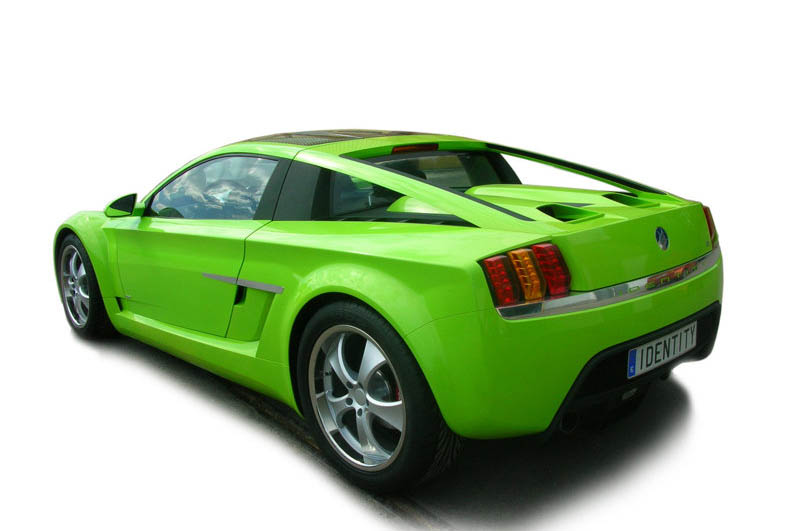
Mazel Identity i1, 2006

Mazel Identity i1, 2006


The Identity i1 has made concrete a proposal which is not only the answer to the challenge of a new model realization but also to the creation of a new brand, a goal which is not easy to reach today.

H2R Design Consulting have studied the concept of the car, developing the design completely in Virtual Reality, and MAZEL-GROUP have executed the physical model. Both companies, located in Barcelona, demonstrate with this project their high technological capacity in the execution of this kind of projects.

The chassis, studied in composite material will be developed with ATR, a prestigious Italian company with a great experience in this field. The development of the body in white (in RTM and composite material) is on its execution phase by Studio Linea 2 in Turin (Italy)

The engine, an aluminum eight cylinder in central position with rear wheel drive with an robotized six gear Gearbox guarantees high performances and an excellent road performance.

The exterior, following the best European tradition, is characterized by generous dimensions (4,43m long per 1,92m wide, is only 1,26 m high) combined with the remarkable tires size of 19" in the front and 20" in the rear, gives the car an exclusive and sporty image. Furthermore the strong character of its designs originates not only a "pure race" sports car but also a design able to characterize a whole new brand.

The front part, consisting of three main volumes, have a lower main air intake, clearly inspirited in aeronautical solutions, which is, beyond all doubt, its most important part. The remarkable intakes for the front brake refrigeration makes up a dynamic ensemble with a strong sports character. The upper air intake, refined and perfectly integrated in the bumpers volume and the head lights in vertical position, emphasize the important width of the vehicle.

The side part is characterized by a new treatment of the surfaces, bringing together new design trends and classic solutions, which permits to obtain a product really different in relation to the solutions actually on the market. The doors, which are opening vertically, reinforce its extremely personal presence. Here, the perfectly integrated external mirror has a new lighting system developed by FICOSA.

The rear part, characterized by its separated rear lights and its remarkable lower engine cover part which is used as an air outlet conductor with a ventury effect, is easily recognizable from afar. This contribute to reach the purpose to make a car with an own, strong character.

The interior, a two seats, has been developed against the traditional solutions searching a sporty elegance combined with a high sensation of space, using a new distribution of the internal mechanical components.

All the control components of the vehicle are situated in the central panel where the Shift by Wire and the Brake by Wire solutions have permitted a new distribution of the gear and hand brake in the interior of the vehicle. This solution gives a new drive sensation. These elements have been developed by FICOSA, who also cooperated with the realization of the design.

Loremo LS Concept, 2006

Loremo LS Concept, 2006


The Loremo is a lightweight vehicle whose development has taken a radical new direction: less is more and the most efficient use of energy is not to use it at all. From this motive new ideas sprang which gradually made it into the design. Even the name Loremo - Low Resistance Mobile - speaks of its streamlining and economy.

The Loremo's construction handbook would make an excellent diet recipe. Slim lines and no unnecessary ballast distinguishes the Loremo from all other cars. Its superior safety concept, excellent aerodynamic characteristics, revolutionary bodywork, the linear cell structure, and a radically new rear-axle keep it in form. It combines the economy of a compact car with the handling and feelings of a sports car. The Loremo LS - light and simple is a car which awakens emotions and yearns for sinuous roads.

Bodywork and chassis concept
The 95kg (209 lb) lightweight steel chassis - a patented linear cell structure - is one of Loremo's key elements. It performs well-above average in crash simulations and provides excellent handling characteristics with its low center of gravity and torsional stiffness. Longitudinal supports, extend at fender height along the length of the entire vehicle, increase stability and ensure that the linear cell structure remains practically undamaged in offset and side crash-tests. The centrally mounted cross-support, on which the roll bars are mounted, stiffens the longitudinal beams and houses the engine.

The non-load-bearing, self-supporting, thermoplastic body panels mould to the linear cell structure and help the Loremo to achieve its aerodynamic shape. This material has a number of advantages: it is light weight, weatherproof, scratch-resistant and it is economical. It substitutes the classical paint by a thin film, in the color of the car, during the manufacturing process. In this way the Loremo receives a high-quality, paint-like surface without environmental- damaging paints.

The intelligent, chassis air-guiding system is perfected with the help of lower tire fins and by the air stream optimized chassis design. The Loremo achieves its optimum driving characteristics with its minimized wind resistance and reduced buoyancy.

Design
Not only is the energy efficiency reflected in the dynamic, elegant lines of the Loremo but also in its sporting nature. The distinctive, powerful front stretches softly into the extended rear. There is no B-pillar as the panorama roof has no load-bearing function and is simply bolted to the roll-bar. The nose close to the street does away with a monstrous radiator grill and instead an opening provides access to the aerodynamic underside. The LED headlamps give the vehicle both a distinctive look as well as exhibiting tomorrow's display technology.

Unusually the car is entered from the front for which the entire hood of the car including the windshield is tipped forwards, allowing for upright boarding to the interior. The opened front shows the trunk, which also provides additional 600 mm (24 in) of crumple zone. The vertically- opening tailgate provides the entry to the back seats.

Interior
The Janusseater - two seats are in front of the pyramidal cross-support and two rear-facing behind it - is equipped with super-light ergonomic seats. The seats, embedded in the linear cell structure, create a feeling of sporty security and comfort. There is plenty of room for sporting equipment or for additional suitcases, if the rear-facing seats are not with passengers.

The spartan, sporty interior design does away with unnecessary fittings and its two-ply plastic construction doesn't need any additional finishing. High-quality interior furnishing in alcantara and high-tech fabrics provides spacious luxury and comfort.

If required the Loremo LS can be equipped with a simple air-conditioning system, an on-board PC with navigation system, an mp3 player, and a driver information system.

Technology
Of particular note is the rear differential-link axle, specially-developed for the Loremo, which combines the advantages of longitudinal- and semi-trailing link axles. With maximum load, the axle is indifferent to toe and camber at full suspension compression. In curves, however, the wheel leans inwards to achieve better lateral traction. An optimal load distribution of 50:50 is achieved by placing the motor centrally and 105/70 R14 low-profile tires give good road holding and perfect straight-line driving.

The 20 PS (15 kw) two-cylinder turbo-diesel motor powers the 450 kg (204 lb) light Loremo LS to up to 160 km/h (100 mph). It accelerates from 0 to 100 km/h (63 mph) in 20 s and its aerodynamic form achieves a Cw value of 0.20. Fuel consumption: tiny 1.5 liters for 100 km (157 mpg)! Thus the Loremo can travel from Munich to Rome (over 800 miles) on only one 20 liter (5 gallon) tank of fuel.

Fisker Latigo CS, 2006

Fisker Latigo CS, 2006


The BMW 6 Series 650Ci Coupe provides the base vehicle architecture for the FISKER LATIGO CS. Signature FISKER cues bring a new gravitas and balance to the luxury sports coupe - it is understated elegance at its best. As in the FISKER TRAMONTO, all electronic, telematic and safety systems remain untouched from the original manufacturer, and every original vehicle option is available.

The FISKER LATIGO CS is currently nearing production status, so final technical details are still in flux. Engine specifications call for a standard 32-valve, 4.8-liter V8 pumping 367 horsepower, and an optional V10 that generates over 550 horsepower if you choose a BMW M6 as your base architecture.

LATIGO CS DESIGN
The LATIGO CS evidences signature Fisker style, with details that can only be done by hand. "Hand craftsmanship is at the forefront of this coachbuild design. Coachbuilding is an art form," explains Henrik Fisker, CEO FISKER COACHBUILD.

FISKER COACHBUILD works with a hand-picked team of classic car body builders, wheelers, panel beaters, wing makers, and fender manufacturers who are highly skilled in their work with aluminum, steel, stainless steel, carbon fiber and magnesium alloy.

The lines of the car bear a tension - like an arrow pulled back in the bow. C-pillars have been redesigned to flow in a more sculptured manner, sitting solidly over rear wheels. Dimensions front and rear have been shortened. A sculptured power dome highlights the hood. Overall, brilliantly balanced proportions lend a solid, unmistakable presence to the FISKER LATIGO CS, while advanced aerodynamic sculpting creates a shape that is virtually invisible to the air.

Exterior detail highlights include:
+ Low ground-hugging stance
+ Lightweight, high-strength carbon fiber and steel define the outer shape
+ Sculptured power dome highlights the hood
+ Slim, beautifully proportioned head lamps tie together the strong front graphic
+ Fog lights inset with carbon fiber bezels on the lower front spoiler
+ Fisker family resemblance with distinctive, black powder-coated grille
+ 3-dimensional milled aluminum and hand painted badge
+ Side indicators set in a chromed aluminum bezel
+ Clean, unbroken lines
+ Carbon fiber rear diffuser sits above twin stainless steel round exhausts
+ Integrated rear bumper design creates a sculptured look and feel
+ C-pillars are designed to sit proportionally correct over rear wheels
+ Lightweight, purpose-designed, 10-spoke, 3-piece 20" wheels

LATIGO CS INTERIOR DESIGN
Inside the FISKER LATIGO CS you see the true art form of custom coachbuild craftsmanship. Interior fit and finish are distinctive. The touch of the finest materials can be felt everywhere. And sumptuous, hand-stitched leather surrounds.

FISKER COACHBUILD has partnered with Distinctive Industries, the American-based leather interior experts, to produce a high-performance, high-luxury environment that is deceptively spacious. Every technological feature remains intact, including the home-theater quality Logic7 audio system and the optional heads-up display.

The creature comforts of the base architecture are all still available - and then some. A myriad of hand-crafted upgrades creates a new level of luxury you'll be sure to notice.

Interior detail enhancements include:
+ Spacious, high-performance and high-luxury environment
+ Aluminum sill plaques engraved with FISKER COACHBUILD, which sit on the polished carbon fiber sill panel
+ Soft, hand-stitched leather throughout the car, including seat backs
+ Hand-stitched three-spoke steering wheel
+ Unique numbering system on an aluminum plaque atop center console
+ Hand-stitched leather headliner
+ Sun roof cover lined with Alcantara leather
+ Milled aluminum accents on the sun visor around the vanity mirror
+ Milled aluminum enhancements to the BMW "iDrive" components
+ Gear shift knob with aluminum and leather incorporates aluminum FISKER logo
+ Driver-facing center console design
Twitter Delicious Facebook Digg Stumbleupon Favorites More